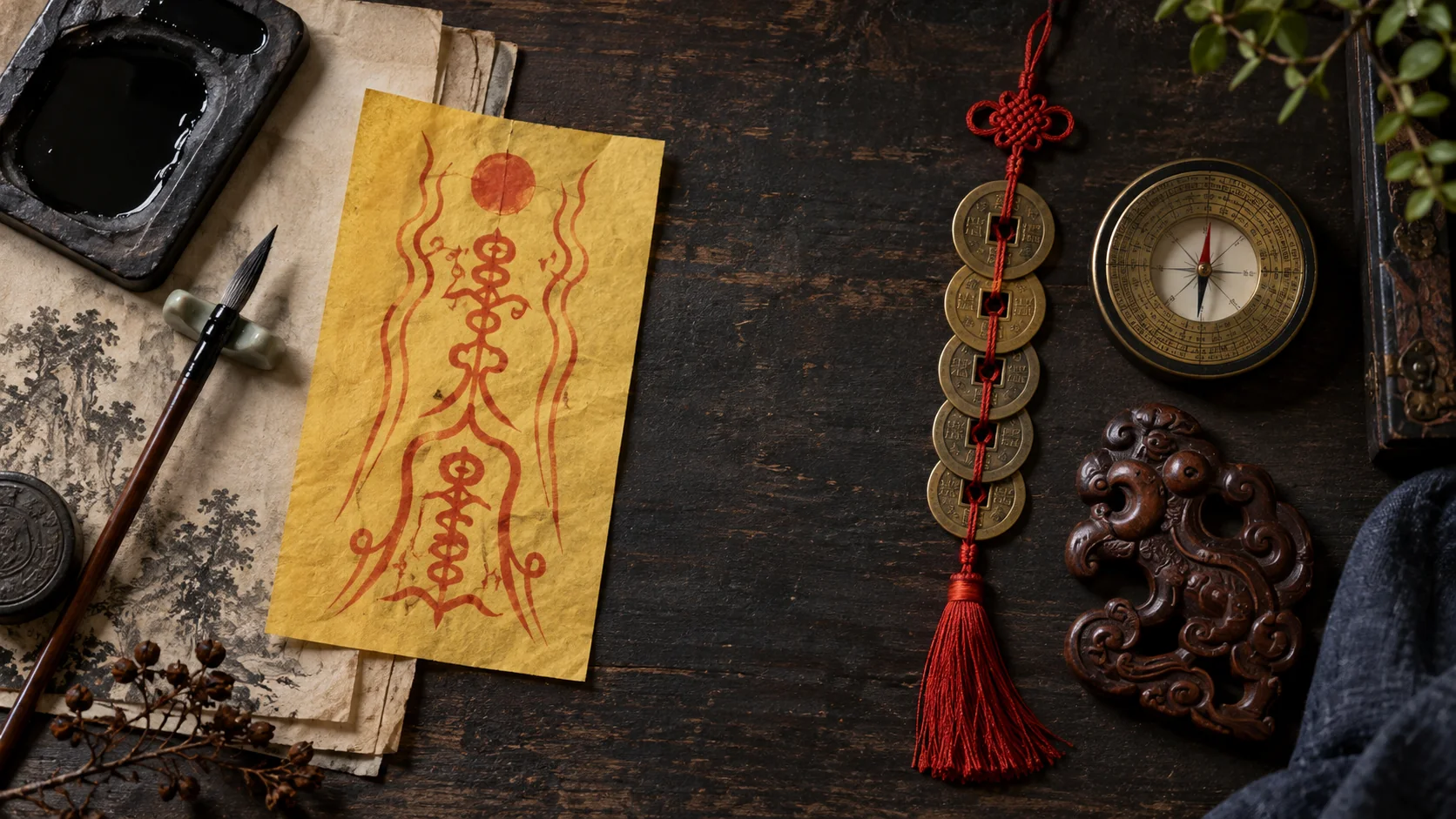
Online shops often place Taoist talismans, feng shui charms, Chinese coins, zodiac objects, and decorative seals in the same category. They may share colors and symbols, but they do not necessarily come from the same practice or serve the same purpose.
Understanding the difference between a Taoist talisman and a feng shui charm helps you buy, display, and discuss these objects more accurately.
What Is a Taoist Talisman?
A Taoist talisman, often called fu in English-language discussions, is associated with ritual writing and a specific religious context. It may combine stylized script, seals, diagrams, invocations, and forms transmitted within a lineage. Its meaning depends on who prepared it, why it was issued, and how it is used.
Not every yellow paper with red marks is a ritually prepared talisman. Some are printed reproductions, teaching examples, decorative artworks, or mass-produced souvenirs. Visual similarity alone cannot establish ritual provenance.
What Is a Feng Shui Charm?
Feng shui is concerned with relationships between people and their built or natural environments. Objects sold as feng shui charms may include coin strings, gourds, mirrors, compass motifs, animals, crystals, or other forms associated with a particular school or popular custom.
Some practitioners use physical objects as reminders or environmental adjustments. Others place greater emphasis on orientation, timing, landscape, building form, and the flow of movement through a space. There is no single object-based method shared by every feng shui school.
The Main Difference: Ritual Instrument and Environmental Object
A Taoist talisman is generally understood through ritual authority, text, and lineage. A feng shui object is generally understood through its relationship to a location, spatial analysis, and symbolic association. In real Chinese religious life, the boundaries can overlap, but the two terms should not be treated as synonyms.
For example, a priest may issue a talisman for a household and give placement instructions. A feng shui consultant may recommend changing a desk position or adding a conventional object after analyzing the room. Both may involve placement, yet the reasoning behind the placement is different.
Materials and Appearance
Taoist talismans are often associated with paper, brushwork, seals, and red pigment, although traditions and formats vary. Feng shui charms are commonly made from metal, wood, stone, ceramic, fabric, or glass. These patterns describe common examples rather than strict rules.
Color is not proof. Yellow paper does not automatically make something Taoist, and a red cord does not automatically make an object a feng shui remedy. Ask about materials, maker, school, and intended use.
Consecration, Preparation, and Personalization
Religious talismans may involve preparation steps that are not visible in the finished object. Claims about consecration should be tied to an identifiable practitioner or temple rather than vague marketing language.
Feng shui items may be selected for a particular building, direction, date, or occupant, but many retail charms are sold as general symbols. Personalization can be meaningful in both contexts, yet it does not guarantee a result.
Placement Rules Are Not Interchangeable
A generic bagua map should not override the instructions supplied with a talisman. Likewise, directions for a ritual paper should not be copied onto every coin string or decorative object. When advice conflicts, return to the source and purpose of the specific item.
If you are consulting professionals, tell each person what objects are already in the space. This helps avoid contradictory recommendations and creates a clearer record.
Questions to Ask Before Buying
Whether you are considering a Taoist talisman or a feng shui charm, ask:
- Who made or selected this item?
- Is it a ritual object, a cultural artwork, or a decorative product?
- What tradition or school informs the instructions?
- What materials and pigments were used?
- Are the placement and care directions provided in writing?
- Does the seller promise guaranteed wealth, healing, or protection?
Responsible sellers describe cultural context and practical care. Extraordinary guarantees, fear-based sales language, and invented titles are warning signs.
Can One Object Be Both?
In some lived traditions, a ritual object may be placed according to spatial considerations, or a consultant may work with religious specialists. Categories in Chinese culture are not always as rigid as modern online stores suggest.
It is still useful to identify the primary context. Ask whether the object was ritually issued, selected through a feng shui assessment, or created as symbolic art. The answer affects how it should be handled.
Cultural Artwork and Personal Faith
Many people value these objects for artistry, family tradition, identity, or personal reflection. Those are meaningful reasons to own them. Cultural respect includes describing them accurately and avoiding guaranteed claims about health, relationships, finances, or safety.
Professional advice remains essential for medical, legal, structural, and financial decisions.
A Clear Way to Remember the Distinction
Think first about context. A Taoist talisman is usually explained through ritual purpose, writing, transmission, and practitioner guidance. A feng shui charm is usually explained through a space, its occupants, and a system of environmental interpretation.
The most trustworthy answer comes from provenance rather than appearance. Knowing who made an object and how they expect it to be used tells you far more than its color, price, or product name.