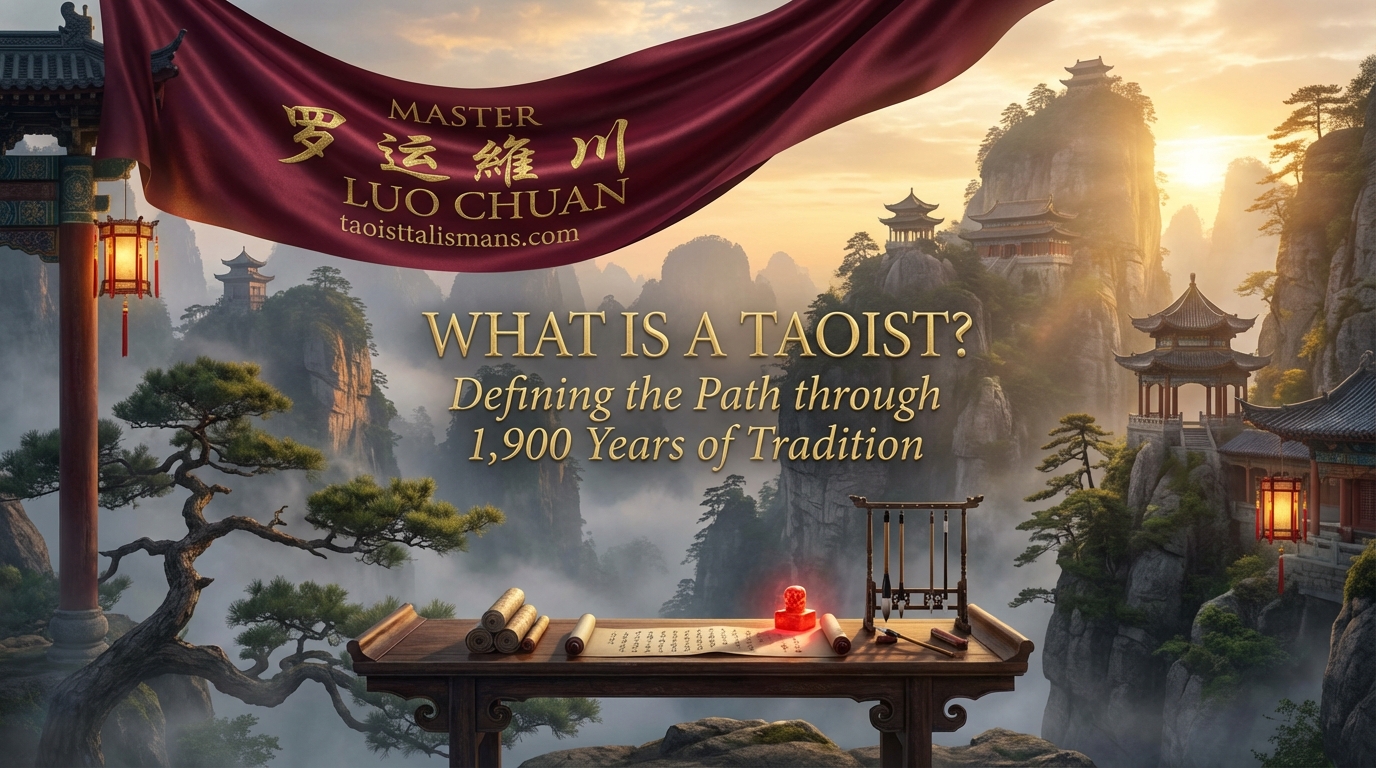
To define what it means to be a Taoist is to embark on a journey that spans nearly two millennia of human history, spiritual inquiry, and cosmic alignment. For many in the West, the word "Taoist" evokes images of ancient hermits in mist-covered mountains or the swirling black-and-white symmetry of the Yin-Yang symbol. However, from the perspective of the Dragon Tiger Mountain Zhengyi School—a lineage I have served as a 63rd-generation master for over 30 years—being a Taoist is far more than an aesthetic or a passive philosophy. It is a rigorous, living practice of "Orthodox Oneness" (Zhengyi), a commitment to harmonizing the human spirit with the celestial laws of the universe.
Understanding the "Tao" in Taoist
At its most fundamental level, a Taoist is a "follower of the Way." The word Tao (道) translates literally to "path" or "road," but in the context of our tradition, it represents the primordial source of all existence. It is the nameless force that preceded the universe and the rhythmic intelligence that governs the stars, the seasons, and the flow of blood through our veins.
To define a Taoist, one must understand that we do not seek to "conquer" nature or "transcend" the world in a way that rejects physical reality. Instead, a Taoist seeks alignment. We believe that when a human being lives in accordance with the Tao, they experience health, clarity, and protection. When they drift away from the Tao—through ego, excess, or disharmony—they encounter "blockages" that manifest as illness, misfortune, or spiritual unrest. As a master of the Zhengyi school, my role is to provide the tools, such as hand-inscribed talismans and sacred rituals, to help individuals clear these blockages and return to the natural flow of the Way.
The Zhengyi Tradition: A Lineage of 1,900 Years
While Taoism has many branches, the definition of a Taoist is deeply influenced by the specific lineage one follows. I represent the Dragon Tiger Mountain (Longhu Shan) Zhengyi School. Our tradition dates back to 142 CE during the Eastern Han Dynasty, founded by the Ancestral Celestial Master, Zhang Daoling.
For nearly 1,900 years, this lineage has remained unbroken. To be a Taoist within the Zhengyi tradition is to be part of a "ritual-based" practice. Unlike some schools that focus solely on internal meditation in isolation, the Zhengyi Taoist is a bridge between the celestial realms and the mundane world. We are practitioners who live within society, often marrying and raising families, while maintaining the sacred protocols of our ancestors.
When I sign my name, Luo Chuan, I am using the generation character "Luo" from the Sacred Generation Poem of the Three Mountains. This is not merely a title; it is a definition of my place in a vast, historical tapestry. It signifies that the wisdom I share—and the talismans I create at taoisttalismans.com—are not modern inventions but are grounded in twenty centuries of verified spiritual efficacy.
The Three Pillars of Taoist Identity
To provide a comprehensive definition, we can look at the three pillars that support the life of a Taoist: Philosophy, Alchemy, and Ritual.
1. Taoist Philosophy (Daojia)
This is the intellectual foundation, primarily rooted in the Dao De Jing by Laozi and the works of Zhuangzi. A Taoist views the world through the lens of Wu Wei (non-contentious action) and Ziran (naturalness). We understand that the hard is overcome by the soft, and that the greatest strength lies in flexibility.
2. Internal and External Alchemy (Neidan and Waidan)
A Taoist is an alchemist of the soul. We work with Qi (life force energy). Through meditation and breathwork, we refine our internal energy. Externally, we use sacred materials—such as the high-grade cinnabar ink I use for my hand-drawn talismans—to interact with the energetic frequencies of the environment. This "alchemy" is the process of turning the lead of common existence into the gold of spiritual enlightenment.
3. Ritual and Liturgy (Daojiao)
In the Zhengyi tradition, a Taoist is also a practitioner of sacred rites. This includes the performance of ceremonies to honor the deities, the clearing of negative attachments from a home (Feng Shui), and the empowerment of talismans. These rituals are the "technology" of Taoism, allowing us to communicate with the unseen forces of the universe to bring about tangible changes in the physical world.
The Role of the Talisman in the Taoist Life
One cannot truly define the practical life of a Zhengyi Taoist without mentioning the Fu (符), or talisman. In our tradition, a talisman is a "celestial edict." It is a physical manifestation of the Tao’s protective and healing power.
When I engage in traditional talisman empowerment, I am not simply drawing symbols on paper. I am entering a state of ritual purity, calling upon the 1,900 years of my lineage, and using cinnabar—a mineral associated with the sun and life-force—to anchor spiritual energy. For a Taoist, the talisman is a tool for harmony. Whether it is for protection, wealth, or health, the talisman serves to remind the wearer’s own spirit to vibrate at the frequency of the Tao. This is the practical application of Taoist definition: using ancient wisdom to solve modern problems.
Being a Taoist in the Modern World
In the 21st century, the definition of a Taoist has expanded to include those who may not be ordained masters but who live by Taoist principles. You do not need to live on Dragon Tiger Mountain to be a Taoist. You become a Taoist when you:
- Practice Balance: You recognize the interplay of Yin and Yang in your daily life, knowing when to act and when to remain still.
- Respect the Lineage: You value the authenticity of traditional transmission over "new age" interpretations that lack historical roots.
- Cultivate Virtue: You follow the "Three Treasures" taught by Laozi: compassion, frugality, and humility.
- Seek Harmony with Nature: You understand that your body and the earth are not separate entities, but reflections of one another.
At taoisttalismans.com, our mission is to make this profound definition accessible. We provide the authentic tools of the Zhengyi school to those who seek spiritual protection and guidance in an increasingly chaotic world.
Conclusion: The Path is Under Your Feet
Ultimately, to define "Taoist" is to describe a person who has stopped fighting against the current of the universe and has learned to sail with it. It is a path of return—returning to your original nature, returning to simplicity, and returning to the source of all things.
Whether you are seeking the protection of a hand-inscribed talisman, the clarity of a Feng Shui consultation, or simply a deeper understanding of ancient wisdom, remember that the Tao is not a destination to be reached. It is the very ground you stand upon and the air you breathe. As a 63rd-generation master, my invitation to you is to stop searching for the Way and start realizing that you are already on it. By embracing the principles of the Zhengyi tradition, you can transform your life from a struggle into a sacred dance with the divine.