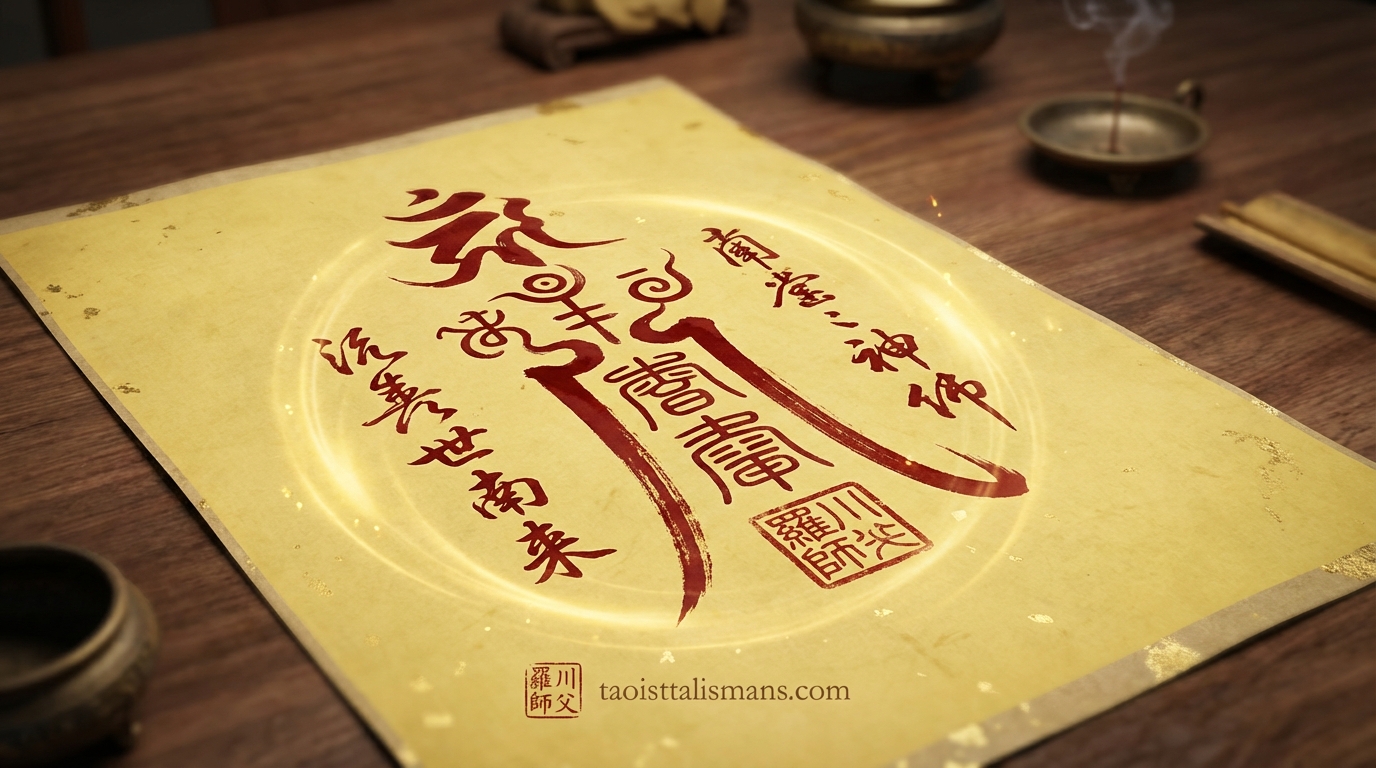
The art of the Taoist talisman, or Fu (符), is one of the most profound and misunderstood practices within the 1,900-year history of the Zhengyi School. For many, these strips of yellow paper inscribed with intricate cinnabar characters are seen as mere curiosities or symbols of folk belief. However, within the Dragon Tiger Mountain tradition, a talisman is a sacred decree—a spiritual bridge connecting the celestial realms with the earthly plane. As a 63rd generation master, I have spent over three decades practicing these arts, and I find that the modern seeker often lacks the foundational understanding required to truly benefit from this ancient wisdom. To approach a talisman is to approach the Dao itself; it requires a balance of respect, knowledge, and spiritual alignment.
1. The Source of Authority: Lineage and the Zhengyi Tradition
The first and most critical basic for any beginner to understand is that a talisman’s efficacy is rooted in its lineage. In the Dragon Tiger Mountain Zhengyi School (龙虎山正一派), our tradition dates back to the Eastern Han Dynasty and the First Celestial Master, Zhang Daoling. When I hand-inscribe a talisman, I am not acting as an individual, but as a vessel for nearly two millennia of unbroken spiritual transmission.
In Taoism, this is known as Fa Tong (法统), or the legal authority of the teachings. Just as a government official requires a seal of office to issue a decree, a Taoist master requires the "command" granted by their lineage to activate a talisman. Without this connection to the ancestral masters and the celestial bureaucracy, a talisman is merely a piece of paper with ink. When you seek a talisman from taoisttalismans.com, you are connecting with the 63rd generation of this sacred history, ensuring that the spiritual "signature" on the paper carries the weight of the Dragon Tiger Mountain tradition.
2. The Anatomy of a Talisman: More Than Just Ink
To the untrained eye, a talisman looks like a chaotic swirl of lines. However, every stroke follows a precise spiritual architecture. A traditional Zhengyi talisman is generally composed of several distinct parts, each serving a specific function in the cosmic hierarchy:
- The Talisman Head (Fu Tou): Usually represented by three dots or specific characters, these signify the Three Purities (San Qing), the highest deities in Taoism. This section invokes the supreme authority of the Dao.
- The Body (Fu Shen): This is the core of the talisman, containing the specific orders or "petitions" to the spiritual realms. It describes the purpose, whether it be for protection, healing, or the clearing of negative energy.
- The Talisman Gall or Heart (Fu Dan): This is the most "secret" part of the talisman. It is often a complex, concentrated knot of strokes that acts as the engine of the talisman. Without the Fu Dan, the talisman has no "heart" and cannot pulsate with energy.
- The Feet (Fu Jiao): These strokes "anchor" the talisman to the physical world, ensuring the spiritual intent manifests in the user's daily life.
Understanding this structure helps the beginner appreciate that Taoist calligraphy is not art for art's sake; it is a form of spiritual engineering.
3. The Material Power: Cinnabar and Hand-Inscription
In the modern age, mass-produced, printed talismans have become common. However, according to the strict protocols of the Zhengyi School, authenticity requires specific materials and manual labor. At the heart of this is Zhu Sha (朱砂), or Cinnabar.
Cinnabar is a naturally occurring mineral that is considered the "purest Yang" substance in the physical world. In Taoist metaphysics, Yang energy represents light, heat, and life, while Yin can represent darkness or stagnation. By using high-grade cinnabar ink, the master infuses the talisman with a potent source of Yang energy that naturally repels malevolent influences.
Furthermore, the act of hand-inscription is a meditative ritual. As I draw each line, I must synchronize my breath, my intention, and my internal Qi. The brush becomes an extension of my spiritual cultivation. A printed talisman lacks this infusion of Qi; it is a photograph of a battery rather than the battery itself. Authentic talismans must be hand-drawn to be "alive."
4. The Role of Ritual: Incantations and Empowerment
A talisman is not "born" the moment the brush leaves the paper. It must undergo a process of empowerment, often referred to as Kai Guang (开光) or "Opening the Light." This involves a series of complex rituals that include:
- Incantations (Zhou): Specific mantras are chanted during the writing process. Each stroke of the brush is often accompanied by a silent or spoken command that "charges" the ink.
- Mudras (Hand Gestures): The master uses specific hand signs to channel energy from the universe into the ritual space.
- Visualization: The master must visualize the specific deity or cosmic force descending into the talisman.
For a beginner, it is important to realize that the "magic" of a talisman is actually a sophisticated technology of the consciousness. It is the result of the master’s decades of practice in internal alchemy and ritual precision. When a talisman is sent out from our sanctuary, it has already been through these rigorous steps to ensure it is spiritually active and ready to serve its purpose.
5. The User’s Connection: Intention and Respect
The final basic knowledge for any beginner is the role of the person receiving the talisman. Taoism teaches the "Trinity of Heaven, Earth, and Man." The talisman provides the Heavenly energy, the materials provide the Earthly energy, but the "Man" (the user) must provide the bridge of sincerity (Cheng).
A talisman is not a "lucky charm" that works regardless of one's actions. It is a spiritual tool that harmonizes the environment. To benefit fully, one must maintain a respectful attitude toward the talisman. This includes:
- Proper Placement: Storing the talisman in a clean, elevated place, or wearing it close to the body as instructed.
- Mindfulness: Aligning one's own thoughts and actions with the purpose of the talisman. If one seeks a talisman for peace but continues to cultivate anger, the internal conflict will dampen the talisman’s effectiveness.
- Taboos: Following specific guidelines, such as not taking the talisman into "impure" places or allowing others to handle it disrespectfully.
Conclusion: A Path to Harmony
The study of Taoist talismans is a journey into the heart of Chinese metaphysics. These sacred instruments are more than just historical artifacts; they are living expressions of a 1,900-year-old wisdom tradition designed to bring balance to a chaotic world. By understanding the importance of lineage, the precision of the talisman’s anatomy, the power of cinnabar, the necessity of ritual, and the role of personal intention, you begin to see the Dao not as an abstract philosophy, but as a practical force for protection and prosperity.
As you explore the offerings at taoisttalismans.com, remember that you are not merely purchasing an object. You are participating in a sacred transmission from Dragon Tiger Mountain. Whether you seek protection, clarity, or a deeper connection to the spiritual realms, may these five basics serve as your foundation for a life lived in harmony with the Dao.